High wire act
Acknowledgements:
First of all there are a lot of people who helped to make our trip great, and it would only be right that we gave them a mention here. First are our colleagues Paola and Roberta. Paola Pucci, who's home town is Auronzo di Cadore (where we stayed) gave us lists of places to visit for food and drink, and people to visit and say 'ciao' too, as well as contact details for family members we could get in touch with if we needed anything. Roberta answered Chris' questions about Italian language and encouraged his learning, as well as tipping us off to the 'spritz' in Venice. Gianni Pais Becher globe-trotting mountain guide, writer and linguist extraordinaire, and his son Giuseppe were always forthcoming when we requested information about ferrati and the weather. Flavio Vecellio and his wife at Camping Europa made us feel welcome and put up with our appalling attempts at Italian. Giovanni at La Stua and a good friend of Paola's managed to engage us in conversation even though we didn't speak Italian and he didn't speak English. The folk at La Pineta supplied us with great pizzas and those at Gelateria D'ambros fed us the greatest ice cream on the planet. Everyone else we encountered is also worthy of our gratitude for their friendliness and patience, and our thanks goes out to them all. We can say without doubt that this part of the world was the most welcoming place we have ever been. Grazie mille.
Needless to say we've been on holiday in Italy again, more specifically The Dolomites, although this time there was no skiing or bicycles, just a bit of via ferrata. If you remember the Italian lesson from our skiing blog, you may be able to deduce that via ferrata means 'iron way'. Essentially it's fixed protection on high mountain walks in the form of cables, ladders and bridges, which allows the likes of us to visit areas that are normally only accessable to crampon-clad ice-axe-swinging mountain types. Equipped with a safety harness, helmet and special device to stop us snapping in half should we be unfortunate enough to have a fall, we were able to walk, scramble, and climb our way over the mountains which was great fun, and very rewarding.
The origins of the ferrati lie in the mountain war of the First World War, or grande guerra as it is known in Italy. As the Italian and Austrian forces fought each other, both attempted to occupy the higher ground in order to gain a strategic advantage over the other. The ferrati were constructed, often at night, in order to provide some form of security to soldiers accessing these high positions. Once all the high peaks had been occupied (and they stayed occupied year-round) both forces took to tunnelling through both rock and ice to build up supply lines and undermine the enemy.
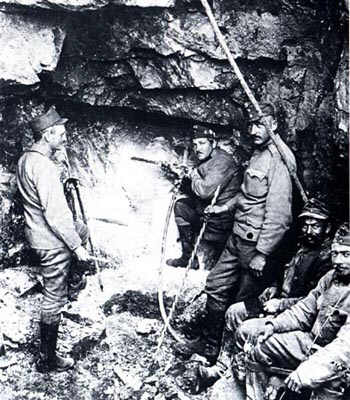
Thousands of metres of tunnels were dug through the mountains, and through the Marmolada Glacier, within which remains from both the war and the fighters are still being found. Ultimately with both sides firmly entrenched the war became one of those most pointless of battles, a war of attrition; and as the fighting continued the mountainous conditions took their toll, ultimately claiming more lives than the fighting itself. In the Mountain War avalanches claimed a staggering 60,000 lives.
Many ferrata have been built subsequent to the war, although the first one we did - Monte Peralba, was an original. Just before we started climbing we saw a strange animal that looked like a cross between a squirrel and a badger, which we later discovered was a Marmot - the first of many we encountered. On the way up we got rained and hailed on, but by the time we reached the top it was a fine day again - an introduction to the strange weather patterns that would hamper our outings for the following week. On the way we saw remnants from the war, including some old buildings and this barbed wire, still lying where it was cleared to, 90 years after the fighting stopped.

The following day we had made some other plans, although we finished them early and were frustrated to sit around in the sun suffering the baking heat of the valley that Auronzo sits in, although it was a good excuse to gorge ourselves on the fantastic local ice-cream. We were even more frustrated the next day though as we set off early to Cima Del Cadin, which was supposed to be an outstanding ferrata with a long section of ladders. However after walking to the refugio from the chairlift and having a quick lunch, we only managed to get to the bottom of the ladders before the cloud closed in. We thought it would be worth trying to go up in case the cloud cleared. Unfortunately we met a huge group of Czech climbers coming down, and with Vonny stuck at a point where passing wasn't easy, and thunder starting to echo around the valley, we decided to ease the traffic flow and head down.

Realising that a bit of practice in passing might be in order, we did an easy ferrata which took in a walk behind a waterfall near Cortina. It made for an easy day as we switched over and under each other whilst maintaining our connection to the wire; and despite our proximity to an enormous torrent of water, we stayed dry.

With renewed confidence in our ability, and simmering with frustration that the days were passing without us ticking off many routes, we decided to take the chairlift up to the top of the Cristallo mountains. It wasn't cheap, so we had high expectations as we ascended in what we suspected was the world's oldest cable car, which was made up of little red and yellow pods that looked like cold and flu pills. Once we arrived at the top we had just enough time to scramble into the refugio before the rain set in. It was a most inauspicious start to what was supposed to be a big day, but after an hour we managed to sneak out and set off on a short walk through the clouds which took in the longest ferrata bridge in The Dolomites. Our altitude was over 3000 metres, so we were wearing all the clothes we had - which felt strange given the sun we'd been enjoying on the previous days.

After returning to the refugio we set off along the ridge in the opposite direction, heading towards Cima di Mezzo. We'd only gone about 200 metres when we heard the rumble of thunder and Vonny suggested we think about heading back. Chris wasn't too keen on the idea and voiced his theory that at altitude, without many geographical features to block it, sound could travel vast distances and the thunder could actually be a very long way away. It was a theory that was accepted so we moved on, only to receive a massive electrical shock through the cable after another 20 metres, which left us with a burning hair smell and numb hands. Given there were no power lines or generators on top of the mountain we could only suppose that lightning had struck near the cable and the charge had travelled through it to us. It was a narrow escape which we put down to the cable being earthed every 10-20 metres, and we headed straight back to the chairlift, thankful to be alive.
Undeterred we set off the following day to do the Paterno ferrata, which is probably one of the most popular in the region. The peak in the background of this photo, Tre Cime di Lavaredo, is one of the most photographed in The Alps.

The ferrata goes through a steep and dark 600m tunnel dug during the war. There are occasional windows offering views like this one.

Once we'd finished the first section we took a bit of a wrong turn, however it worked out okay as we continued along a ridge without any other climbers on it, which made a bit of a change from the motorway of the previous section. Click on the photo below for a great action shot of Vonny - the kind of thing that gets mothers worrying.

One of the fantastic things about this holiday was that we were right up on top of the mountains, when we'd normally be gazing up at them from below. Admittedly we encountered problems that normally wouldn't have bothered us so much, like the weather, however we got so much out of being in an environment that is normally beyond our reach, and of course the view down was fantastic (although a constant reminder of how far we had to go until we could relax).

The Paterno ferrata was enough to finish Vonny off, as she was getting more tired with every day, and this was supposed to be a holiday after all. We decided that Chris would go and do some ferrati on his own, the first being a remote walk back to Auronzo from the neighbouring village of Padola. After being dropped off by Vonny (who took a trip to Austria to fill in the day) he didn't see another person for 5 hours. That's got to be the longest period of isolation outside of our house that either of us has had since we left New Zealand back in 2002. Unfortunately he lost a contact lens just after leaving the car, so everything was two-dimensional for 5 hours, and that's not a great thing when you're trying to walk downhill on rough ground.
The following day it was another solo trip for Chris, this time the Michielli Strobel ferrata. This was exactly the kind of climbing he'd been looking for, with steep faces and not too much walking. Needless to say when you're using both hands to hold on, taking photos presents it's own problems, however a few came out okay. That's the town of Cortina d'Ampezzo in the background.

Unfortunately it was to be the last ferrata, as the weather packed up that afternoon and wasn't going to get any better for a few days. After a last pizza and packing ourselves full of ice cream we headed back towards the airport, stopping in the town of Belluno for a bit of a look on the way. It was quite nice, with lots of very old frescos on the buildings.
Although we dropped the car at the airport, we weren't quite ready to head home, as we'd planned two days in Venice - which seemed sensible given we were in the region and hadn't been there before. Everything people had told us about Venice turned out to be true; it was crowded to a standard that even Londoners couldn't comprehend, very expensive, and the food was awful. However the moment we walked out the door of the railway station it looked exactly like it did in the pictures, and that made it unique. It's rare to find a place that lives up to the hype so instantly.

We just wandered around the city, doing a walking tour which got us away from the crowds for a short while. Venice would make a great place for an orienteering competition, as the twisting combination of canals and streets means it's a huge maze that takes absolute concentration to navigate. Of course if you're not in a hurry you could just do what we did and take a chance by following someone who looks like they know where they are going - not the guy in this picture!

We eventually made it to Piazza San Marco, and it was so busy it made Trafalgar Square look like a desert. It was hard to work out what all the fuss was about, as although the buildings were nice to look at, the architecture was dreadfully unbalanced. We even saw a man with tā moko there, which shows the place draws visitors from all corners of the globe.

As we mentioned in the intro, we did our best to partake in the regional drink, Spritz. It's basically wine and carbonated water with a dash of campari. If you've ever tried the chinese herbal remedy Astra Forte you've got an idea of what it tastes like - dreadful, but strangely addictive.

Despite our issues with the weather, we seemed to have timed our trip in the mountains brilliantly for the alpine plants that were flowering. We took a few photos of them and you can view them on Flickr by clicking on this link. Those pictures with a stoney background were plants growing right up near the top of the peaks we climbed, often in very inhospitable conditions.
All up it was a fantastic trip, and we really enjoyed the people, as well as the activities and the scenery. Although it's the third time we've been to Italy this year, it felt like the first time we actually interacted with Italian people (outside of work of course :-). We found everyone to be helpful, friendly, and generous. It is certainly a place worth visiting, and there's a very good chance we'll be going back again some time. For now however it's to be our last trip to Europe - our colleagues are asking when we'll start coming to work regularly, which is a sure sign our extended absences have been noted.
posted by Vonny & Chris @ 2:15 pm
1 comments

Thursday, July 17, 2008
Weekend in Cornwall
This is another late posting, but we had a couple of nice pictures of our trip to Cornwall at the end of last month (June), and thought we'd put them up for you all to see.
Initially we'd planned to go to the beach for a surfing break, however we found out that The Verve were playing at The Eden Project on the same weekend, and as we were planning to go that way we thought it would be worth attending. We'd wanted to visit the Eden Project again since we'd been in 2006, and as the concert ticket came with free access on the following day, it seemed like a good deal.
Ultimately we didn't need to make another visit on the Saturday as we arrived on Friday night for a 7pm start to find out that the band wouldn't come on stage until 9:15. It seems that a lot of other people had done the same thing and that made for a great atmosphere, as everyone was enjoying wandering through the gardens and biomes with a glass of wine or a beer. It was a relaxed and brilliant way to see the Eden Project.
The concert itself was great, and Richard Ashcroft was a very cocky but great showman. They played lots of songs we know and had wanted to hear, and a few others that we hadn't heard before including their new single and the b-side to their first single (which had been requested by fans on the internet). Being good law-abiding citizens we didn't take a camera to the concert, however someone else did so here's a few of their pictures from Flickr. During the gig there were intermittent rain showers which caught the lights, and made the whole thing all the more etherial.


The next day we slept in a bit, and after a short run and a swim to cool off, we headed to Mevagissey. Chris' grandparents had brought David here when he was just a few years old for a holiday before they moved out to New Zealand in 1950. Here's a picture of Ellen and the young David in the town at the time.

We thought it was a really nice spot, and had a great few hours wandering about the narrow streets and around the harbour.


The next day we did a bit more snoozing, before heading off to Looe for the morning. It wasn't as nice as Mevagissey, but Vonny picked up some cheap polaroid sunglasses which came in useful when looking into the river which divides the town. Although we'd taken the cooker with us, we never used it as we took advantage of the local bakeries and survived on Cornish Pasties for the whole weekend.
We had plenty of time for the trip home so stopped off in the town of Wellington in Somerset, namesake of our home town in New Zealand via the connection with Arthur Wellesley. It was suprisingly un-impressive, although we had to go there to find that out for oursleves.

We had a great weekend, not due just to the stuff we did in Cornwall, but also to the hire car we had. We'd been upgraded to a VW Golf which was a diesel, and the fuel consumption was so low the cost of the trip was about half what it would have been in our old car. Chris also had a Sat-nav and other gizmo's to play with whilst Vonny was driving. What's more there's nothing like a long weekend knowing that you're going away on a big holiday three days later. Yay!
posted by Vonny & Chris @ 7:33 pm
2 comments
Previous Posts
- Late '08 update
- High wire act
- Weekend in Cornwall
- Switzerland by bike Pt.2
- Auf Weidersehen Der Baron
- Amsterdam
- Bicycles in Amsterdam
- Sci Italia
- Things go bad in Andalucia
- Technical note
Archives
- January 2005
- February 2005
- March 2005
- April 2005
- May 2005
- June 2005
- July 2005
- August 2005
- September 2005
- November 2005
- January 2006
- May 2006
- March 2007
- June 2007
- September 2007
- November 2007
- January 2008
- April 2008
- May 2008
- June 2008
- July 2008
- December 2008
- Current Posts
